
Introduction
With as much as being offered by large cap and multi cap equity mutual funds for long-term wealth creation, it can be overwhelming to choose the right category of equity mutual fund. Both invest in stocks, but differ significantly with regards to risk, diversification, and growth potential. The first step to creating a sound portfolio is to understand these differences.
Understanding Large Cap Mutual Funds and Multi Cap Funds
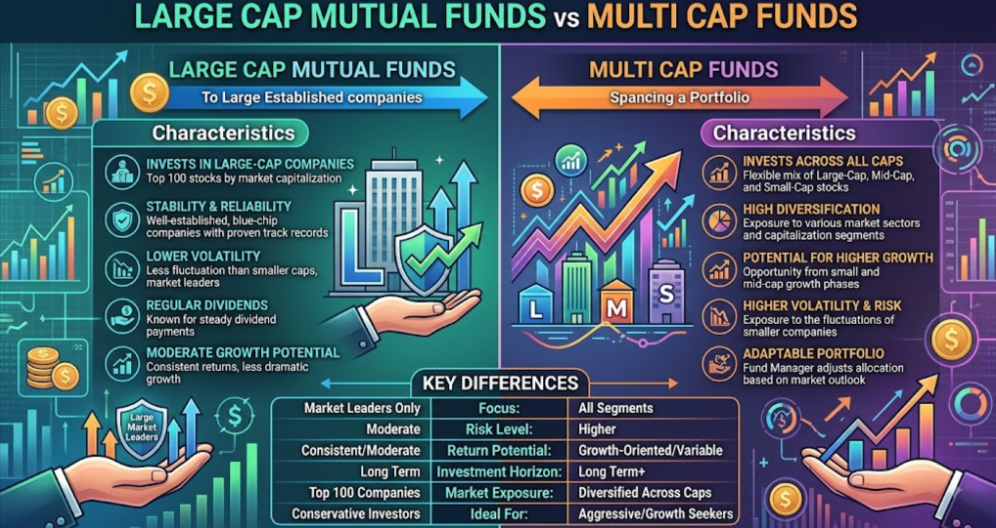
Based on market capitalization, large cap mutual funds generally invest in India’s top 100 companies. These are financially stable and well established businesses. Multi cap funds spread their investments across large, mid and small cap companies. SEBI mandates that multicap funds have at least 25 per cent exposure each to largecap, midcap and smallcap stocks and the remaining 25 per cent can be invested at the fund manager’s discretion. This structural difference is what gives multi cap funds their higher growth potential alongside relatively higher volatility.
Large Cap Mutual Funds vs Multi Cap Funds: Key Differences
| Parameter | Large Cap Mutual Funds | Multi Cap Funds |
| Market Cap Exposure | Predominantly top 100 companies | Large, mid, and small-cap mix |
| Risk Level | Relatively lower | Moderate to high |
| Growth Potential | Steady, stable growth | Higher long-term growth potential |
| Volatility | Lower | Higher, due to mid/small-cap exposure |
| Ideal Investor | Conservative to moderate risk-takers | Investors seeking diversification and growth |
| Suitability | Portfolio stability | Long-term wealth creation |
India’s Top 5 Large Cap Mutual Funds (5-Year Returns)
Here is a look at some of the well-known names in this category and their approximate five-year performance:
- Nippon India Large Cap Fund Growth: Based on 5-year returns, Nippon India Large Cap Fund leads at 14.8% CAGR with a 5-star Value Research rating.
- ICICI Prudential Large Cap Fund Growth: Over the last 3 and 5 years the fund has given a CAGR return of 12.4% and 12.9% respectively.
- HSBC Large Cap Fund Growth: Over the last 3 and 5 years the fund has given a CAGR return of 10.2% and 9.9% respectively.
- Kotak Large Cap Fund – Growth: The fund has delivered steady long-term performance, with a CAGR of around 14.8% since inception.
- HDFC Large Cap Fund – Growth: Since launch, it has delivered 17.98% average annual returns.
Together, these make up a solid list of the top 5 large cap mutual funds worth evaluating for stability-focused portfolios.
Top 5 Multi Cap Funds in India (5-Year Returns)
The multicap and bendable cap groups have also done well for a number of well-known brands:
- Nippon India Multi Cap Fund Growth: A Rs 15,000 monthly SIP over 5 years, with a total investment in 5 years: Rs 9,00,000, has produced a maturity value: Rs 13,28,999.
- HDFC Flexi Cap Fund – Growth: The HDFC Flexi Cap Direct Plan-Growth has given 16.7% annualized returns in the past three years and 17.7% in the last 5 years.
- Mahindra Manulife Multi Cap Fund Growth: The fund has given a 15.5 per cent annualised return over the past five years.
- Parag Parikh Flexi Cap Fund Growth: Its three-year annualised return is 13.7%, and over five years, the fund has delivered 12.8%, well ahead of the benchmark.
- ICICI Prudential Multicap Fund Growth: Over the preceding five years, the fund has achieved an annualized return of 15.20%.
These figures make a compelling case for why investors continue exploring multi cap funds in India for higher long-term growth.
Large Cap Mutual Funds vs Multi Cap Funds: Detailed Comparison
The difference is more pronounced when side by side. The large cap funds from the likes of Nippon India and ICICI Prudential typically have a more predictable performance as they invest in established blue chip businesses. However, multi cap funds have demonstrated the capacity to generate higher CAGR over five-year periods. Multicap funds are ideal for investors looking for a balanced mix of stability and growth as largecap funds provide stability and midcap and smallcap funds have the potential to deliver higher returns over a period of time. This allows multi cap portfolios to tap into the upside of smaller, faster growing companies while still having a large cap cushion.
Which Fund Category Is Better for Long-Term Wealth Creation?
Multi cap funds in India generally make a stronger case for long-term wealth creation for investors with a longer time horizon and a reasonable risk appetite. Given the inbuilt diversification across market capitalisations, these funds benefit from the stability of large caps and higher growth trajectory of mid and small cap companies. As can be seen in the comparison of returns above, some multi cap and flexi cap funds have beaten even the top 5 large cap mutual funds for the past 5 years and are a good choice for investors who are willing to stay invested through market cycles. However, there is still a place for large cap funds in the role of minimizing overall portfolio volatility, particularly for conservative investors.
Factors to Consider Before Investing
There are a few things to consider when deciding which category to go for:
- Your personal investment time frame and level of risk tolerance
- The fund’s historical consistency across multiple market cycles, not just one good year
- Expense ratio and its impact on long-term compounding
- Where the fund manager has invested money in the past and how they think about it
- Whether your existing portfolio already has adequate large-cap exposure
Common Mistakes Investors Should Avoid
- Running after quick profits without due consideration to consistency over the long term
- Comparing types of funds that are similar without looking at expense ratios
- Investing a lump sum without assessing market conditions
- Overlooking the SIP route, which helps average out volatility over time
- Failing to review and rebalance the portfolio periodically
Conclusion
Large cap and multi cap funds have a role to play in a well-rounded investment strategy. Multi cap funds in India have shown greater growth potential for investors with a long-term outlook than the top 5 large cap mutual funds, which offer stability and steady compounding. Ultimately the best choice will be down to the individual risk appetite, financial goals and investment horizon, and a blend of both categories will often serve investors best.